Friday, October 18, 2013

Super Simple Fall Math Game

Fall math game


Today’s super simple math game took about five minutes to create and set up. If you would like to make one for some of your favorite little people here’s a list of materials:

Materials:
Playdough - ours is home made and it smells like vanilla, so it’s perfect for fall!
Leaf gems - found at Target in the dollar bin.
2 Wooden cubes - mine were snagged from a building set but you could also find them in the craft store if you don’t have any laying around.


To set up the game: 

1.) Place the gems in a container in the center of the table. 
2.) Give each child a lump of play dough


To Play: 

The first player tosses the dice, identifies the number on the die then chooses that many gems to push into his / her play dough. When s/he is finished pass the die to the next player.


The really great thing about this game is that younger children can play with the dough and gems while waiting for the next turn because waiting can be such a L-O-N-G time when you are little. 


Also I made 2 dice numbered 1-6 and 7-12 but these guys were only able to wait, count and identify up to 6. If I had added the second set of dice I would have lost them so we will try it again when they are ready for something a little more challenging. 

To vary the difficulty consider the following adaptions to the game.

For younger players use only one die numbered 1-6.
For older players use two dice numbered 1 - 12.
Make all the dice double digits and practice identifying larger groups of objects. 


Saturday, October 5, 2013

Daycare On a Dime


For any of my fellow Daycare Divas and teaching friends out there looking for a great way to outfit their classroom cupboards on a dime I urge you to consider hitting up your local mom to mom sales. These amazing sales are an awesome place to scoop up great deals on gently used items. 

For those of you live under a rock and haven’t heard of mom to mom sales you should know they are magical sales usually take place in churches or schools on Saturday mornings between 9:00 and 1:00. If you don’t have any darlings of your own getting up early Saturday morning for daycare purposes might seem like a waste of a perfectly good opportunity to sleep in but as they say, the early bird gets the worm. Plus it’s WAY better than hitting random garage sales in hopes of stumbling across a fantastic find because almost EVERYTHING in the place is geared for children under the age of five.


A few things to keep in mind....

  • Be aware of recalled items, especially when purchasing infant items like highchairs, swings, cribs and strollers.
  • Never ever, ever buy car seats second hand!
  • Hit up the sales in upscale neighborhoods because rich kids have tons of cool stuff that they hardly ever use and it’s all in pristine condition.
  • Double check to see if all the pieces are in the box, believe it or not some people will try to pass off their junk for a few bucks knowing it’s crap - I’m pretty sure there’s a special place in hell for them.
  • Go in with a dollar amount in mind, or you will likely overspend. (That being said I have to leave my purse at home and only bring cash otherwise I will go to the ATM because I have no restraint when it comes to buying kids stuff.)
  • Keep a running list of things you need in your phone so when you get there you will remember what you are looking for.
  • Go early if you are looking for big ticket items like train tables and jogging strollers the good stuff goes quick.
  • Stay late if you want to scoop up deals from over worked moms who don’t want to drag a bunch of crap back to their car.
  • Keep track of your purchases they are tax deductions!


Mom to mom finds of the day.....

I went in with 20.00 determined not to spend a dime over that and this is what I came out with.


A bag of penguins and five Arctic books for 2.00, how cool is that? I will use it in my sensory bin during the winter for sure! I’ll probably add it to a giant hunk of foam or packing peanuts for building igloos, we could google the different kinds of penguins to learn about what makes them unique.... there are at least ten uses for these guys right off the top of my head.


I also found this awesome race track to continue our investigation of downward slopes, gravitational pull and speed. We could also use it as a springboard for conversations about simple machines and levers. Four cars are loaded at the top then you hit the lever and they all go flying down the track, as the track narrows more two cars go careening off either side until finally one car hits the finish line. Love that it folds up for easy storage too!


Below in my stash is a little collection of cars will be great for our small world construction sites or to be tossed in our beautiful new sand box once it has sand.


 I also found a Connect Four launching game, I spy, Critter Crash, Playskool play tiles, alphabet Beads, Sparkly Beads, some science books, a word building game and a puzzle.

Construct, Deconstruct and Reconstruct to nurture flexible thinking

When I’m looking at board games I always look for ones that have good nuts and bolts. Something we can take a part and use for a few different things other than what the game was originally intended for. It's good for baby brains and good for my overstuffed toy shelves  Also using parts of games for different activities encourages kids to think outside the box and to use things creatively in their play. 

Some examples of open ended use of games are:


This critter crash - This game can be used for patterning, sorting, building, counting, adding groups of objects or pressing into clay (the pieces are textured). 


This connect four launcher - This game has two launchers that promise all sorts of fun for the kiddies in making up target games or shooting across the light table and keeping score. We can also use the acrylic trays for sorting / counting / observing small items on the light table. The launching disks can also be used in stringing projects, or for dropping on pegs. We could also use the disks for placing over specific letters for letter hunt games on paper.


This little building kit was not quite as awesome as I hoped it would be but it still has lots of potential. I broke one of my own rules by not looking in the box before buying it. Instead I asked the mom if it had all it’s pieces, she said it did but she was wrong. Four pieces and the diagram cards were missing. I was a little bummed about it but after playing with the pieces I decided it is going to be a “what can you imagine” kind of a thing. The kids know that when I set out a tray of objects and say "What can you imagine?" I am looking forward to seeing how their own ideas emerge as they work with the objects.

The building kit does have a working motor so it’s good for building simple machines that move. I'm sure my little engineers will conjure up something cool with it. 

As a way to extend their thinking we will take photos of the children's creations before they are dismantled during project time. Later in our large group discussion I will pull the pictures up on the computer screen then ask each of the children to share the steps they used to construct their own machines. The pictures will serve as a prompt to help them recall and retell their process in building.


Kickin’ it old school....

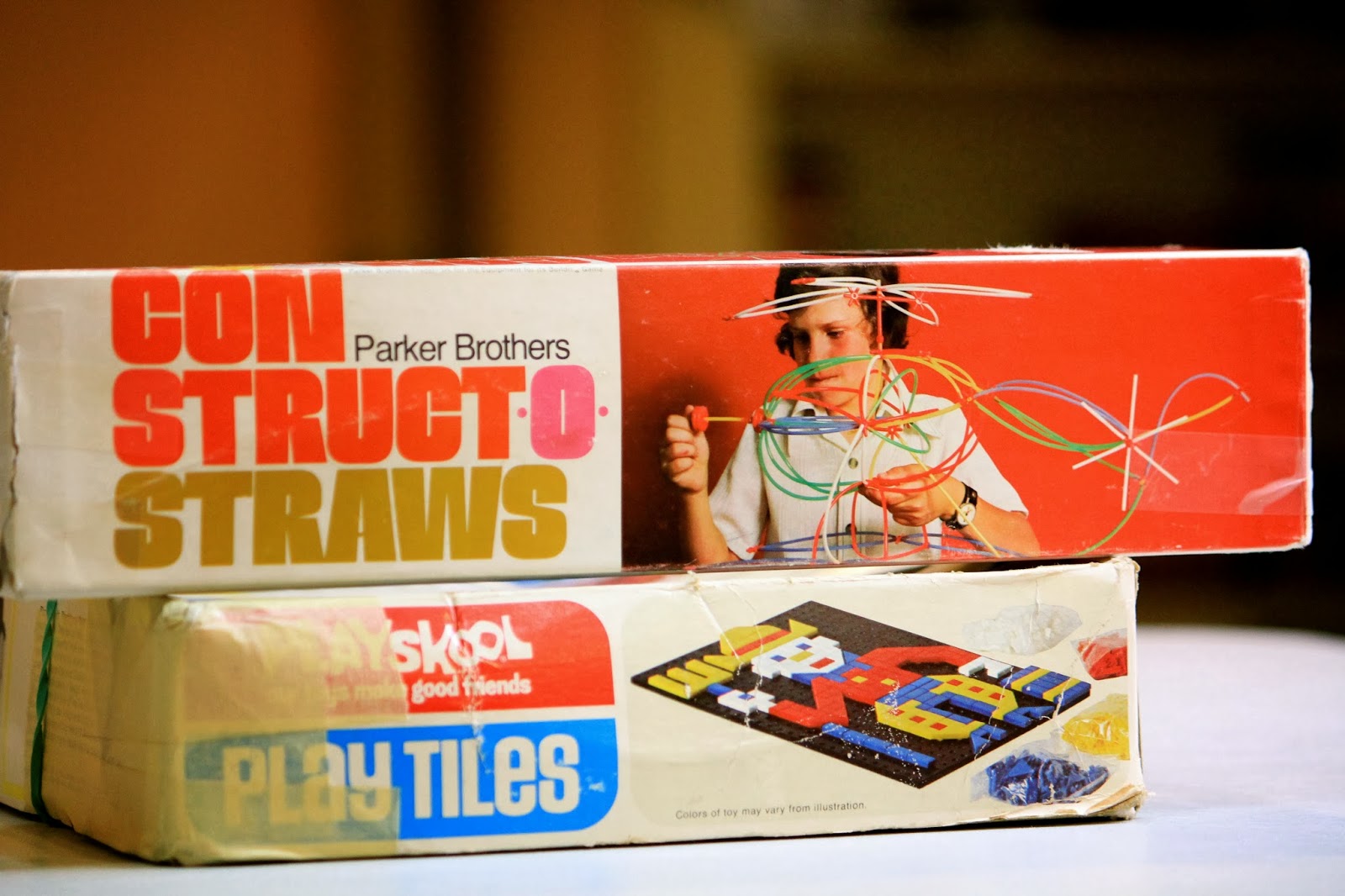
Sometimes I come across really old school games like Connect O Straws and this Playskool tile game. They are usually a lovely shade of burnt orange or avocado green and sold in boxes held together by yellowing masking tape. These little gems always make me smile. They are super cheap and kind of ugly so it’s easy to overlook their hidden potential. Toys from the 70’s are the best open ended toys on the table. Their simple design and no fuss no muss pieces are a great workout for the imagination.


Last week the kids used connect o straws to build some really cool things on the light table, can't wait to see what they come up with while using all our cool new stuff next week :)


Wednesday, October 2, 2013

Experimenting With Angles and Moving Objects


PHASE I
The other day the kids made up a racing game with the cars, some cardboard tubes and some plastic tracks. As they worked together and separately they experimented with shooting the cars down the tubes from various angles. They seemed especially interested in getting the most cumbersome tubes to rest on the top of the sandbox seats, then they would climb up on the seats to peer down the tubes as they sent the cars careening down the tubes. This game went on for quite some time and the tracks took on many different shapes throughout the course of their experiments.


The children took joy in discovering how to extend the tubes, add other pieces to the tracks or change the look of the tracks by stacking closed tubes on top of open tracks. They also set up little cross roads by setting smaller tubes across the tops of larger tubes. 

PHASE II

Noticing their interest in the plastic tracks and cars, I decided to pull the remainder of our tubes out and give them a scrub so we would have more tracks to work with in the upcoming days. The children love all sorts of washing projects so we ended up with a crowd of boys who wanted to help wash the tracks. As they cleaned the tracks they discovered that they could make little chutes to direct the water off the end of the table. I wondered aloud if he could they could find a way to use the chutes to fill a bucket with warm soapy water. They got to work experimenting with positioning a bucket under the chute - it took several tries but eventually they got it. 

After working with the bucket one of my little guys seemed interested in finding a way to extend the track by positioning some tracks next to each other. The tracks didn’t stay together very well and we were running out of time for the activity so we decided we would take a look at how we could make longer tracks another time.

PHASE III

For our third investigation of angles, tracks and extending tracks I set up this waterworks station:


The crates serve as the highest point, then the largest rain gutter extends over the water bin and that runs down into a third level - the water table. I also added this little work table and a step stool for the children to climb up on so that they could see the highest level of the waterworks. They really enjoyed the challenge of climbing up to the highest level without spilling their water! 


We also had this little water bottle set up on the side for the children to practice filling their cups as they waited for a turn to climb or work in the most coveted spaces around the table. 


Some of the things we noticed while working: 
A watches as the corks are carried down the track and over the edge to the sensory bin below. While she works, the track slips and is positioned so that it forms a bridge rather than a downward slope. A looks confused so she moves it back and forth for a bit until she thinks she has fixed it. She tests the track again but the water does not move as quickly so she goes to the end and dumps a larger amount of water off the edge of the track. After watching her work I asked her “What do you think would happen if you moved the track up a little higher?” She moved the track up to the highest point so that it created a dramatic downward slope and the water / corks moved very quickly to the bottom bin. All of the other children came to see her track. 


While working at the water table S watches his corks move down the track and off the table. He repeats the process several times and as he works his track moves so that the downward slope of the track moves in the opposite direction. He dumps a cup of water onto the track and all of his corks go down the slope into the sensory bin. S notices the movement in the opposite direction and says “Hey! they’re going the wrong way.” Then he continues to dump water on the tracks and watch the corks move in the opposite direction.


Our youngest waterworks participant was primarily concerned with filling / dumping cups of water then watching it run off the end of the rain gutter into his cup. He also put several corks on top of the crates and dumped cups of water over the corks until the flow pushed the corks through the crate holes into the stack of crates. Then he peered through the holes to see where they went.


While working with the water spigot some of the newer children were having trouble figuring out how to get the water out. The children who had more experience with the tricky spigot helped figure out how to position the container just right so that water would come out. As they worked together on the project the other children were patient with the child who was trying to figure out how to get it to work, then they all took joy in his success when he finally accomplished his goal. 


Tuesday, September 17, 2013

Counting Gems on the Light Table


One of my favorite projects this week was the counting game we worked on at the light table. This little game was pretty simple to put together. If you would like to make some for your peeps you will need:
  • Small adhesive frames (mine came from Arts and Scraps),
  • velum or drafting paper, 
  • sharpies
  • glass gems
I made the number cards by placing a frame on some drafting paper, drawing the number then trimming off the excess paper. When I was finished they looked like this. 


Then I set up the invitation for the game by placing one acrylic tray of numbers and a second tray of gems on the table like this ....


As more children were drawn to the table, a game emerged. Each child drew a card from the pile then counted out the appropriate number of gems from the pile to place on the card. As the children waited for their turn with the cards, they lined up their gems in different configurations and counted to themselves.


Simple and beautiful!

Thursday, September 12, 2013

Juicing with Josh and G!


I was at a party this weekend chatting with a friend who mentioned that she liked our projects but thought it would be helpful if I added some insight as to how we come up with inspiration for the things we do. It’s funny because before she asked the question I never really thought that anyone would be interested in hearing about the Willy Wonka think tank inside my head that churns out projects. That thing is always droning on and on and on.... even in my sleep!


The children sniffed lemon, ginger, oregano, basil and rosemary. We’ve had many conversations about how herbs have powerful antioxidants to clean out the insides of our bodies. Often the kids will graze on herbs from the garden during play in the outdoor classroom.

Truth be told, half the time I’m not really sure what we are going to do until I am in the midst of gathering supplies for a project and even then things are subject to change. Ideas just sort of emerge and take on a life of their own. Often one project gives birth to another and another and another until it fizzles out then I scavenge around for something new to explore. Sometimes our project plans are fantastic, other times they’re not - every once in a while things go dastardly awry and it’s an absolute failure. On those days we learn that failure can be a really great teacher of patience and persistence. We still end up learning something, just not the thing we set out to discover.


The actual inspiration for our projects comes from a variety of places; following the children’s play, observing other AMAZING teachers at work, stumbling across a long lost toy, surfing Pinterest, pictures in magazines, art shows, concerts, window displays at the mall, a gazillion books or some random thing I think the kids might find interesting from my own personal hobbies. Where ever I go I am always on the look out for unique things to share with the children, and when the right combination of elements come together, voila! a project is born.

Going to Arts, Beats and Eats had a lot of really great inspirational pieces for mixed media art projects. I met the coolest artist who helped me trouble shoot on some of our "failed" glass projects from last year.


The inspiration for this particular project came from watching the documentary Fat, Sick and Nearly Dead with my husband. It sounds like a depressing place for a children's project to be born but the documentary was actually pretty empowering. In the film Joe Cross goes on a 60 day juice fast to see if he can rid hid body of toxins and ditch the medications he relies on to keep his autoimmune disorder in check. He inspires a bunch people, who inspire a bunch of other people and pretty soon the whole thing takes on a life of it's own. If you would like to hear more about Joe’s amazing story you can check it out here. 

Kale, apple, carrot, ginger juice - looks and sounds disgusting but it's actually pretty awesome! The kids all asked for seconds.

In his travels, Joe spreads the good word about the harnessing the power of plants as a means to provide the human body with the ability to heal itself. The subject of nutrition is particularly important to us, because my husband lives with pancreatitis.  Josh has never had a drinking problem or any of the other pre existing conditions that can cause pancreatitis so understanding the underlying cause and management of his illness has been a challenge for both of us. Slowly we are making progress and working together to re-imagine our version of living happily ever after as we work together to find ways to restore his health. 
  

Washing, chopping and juicing veggies is a great way to explore new foods in a non threatening way.


Our personal story has this whole trickle down effect on how we interact with the children. We believe strongly in putting children in control of their own well being by educating them in ways that they can care for their own bodies. We talk about all the things our bodies are telling us so that they know they have the power to change the way they feel. For instance, our real life discussions such as: If you can't make poop, your body probably needs more vegetables, if your tummy is upset, it might be trying to get rid of some germs, if you can't sit still, your body needs to run and if your body is out of control, you might need a minute to "get it together" before you are ready work on your problem - happen on a regular basis.   


After hearing about Josh's cat scan the kids wanted to Google the procedure to learn more about it. Later they helped him practice for his appointment by pretending to be doctors then they built an ambulance in the dramatic play area.

In our little realm the kids know about Josh’s condition; we talk about it often so that they understand why he doesn't feel up for wrestling some days or why he doesn’t eat lunch with the rest of us. We all care about Josh so his health serves as a meaningful representation of what it means to take responsibility for your personal well being. Discussions about how he is working to heal his body by eating more vegetables, fruits, herbs and healthy grains are more meaningful because he is their role model. As Josh and I discover the nutritional value of foods we introduce into our diet, we share our new foods with the children. We also talk about other foods like hot dogs and chicken nuggets that are okay to eat sometimes but aren’t as healthy as a nice chicken breast or herb filled pesto. 

Pulp makes a great sensory experience in the outside kitchen. The kids made all sorts of “pies,” “salads,” and “soups”. They enjoyed smashing, mixing and sniffing it as they worked.

Giving children the wisdom to understand how their bodies work is a gift they will carry with them throughout their lives. Putting it in real life context and practicing every day makes it something they are likely to pack away in their little tool belt for success when they venture out in the world beyond our doors.


Thursday, September 5, 2013

If I had three wishes for every preschooler.....


I recently wrapped up a few interviews with prospective families and somewhere in the middle of my 2 hour long spiel parents of older children always say, “Your program looks great but do you offer preschool?” I feel like it’s a trick question, if I say “yes” will they be waiting on pins and needles for that first number / letter worksheet? If I say “no” will they think the children are wandering around bored out of their tiny skulls losing I.Q. points by the day? My response is usually something along the lines of “Yes but it looks a whole lot more like kids just having fun than a preschool curriculum.” 

Then I hope they aren’t too disappointed when their child’s first art project is a massive glob of paint that gets tossed in the trash once it’s served it’s purpose of demonstrating color transformation of many shades of brown.

This year's first official art project made its way to the trash when we were finished. While there was no tangible evidence that any learning took place, by day's end we made some really great observations about the color brown.

I could have given the kids a squirt of brown paint and a cut out of a bear with the instructions to paint a brown bear for the letter B but then they would have missed out on some valuable opportunities.  For instance, brown bear cut outs don’t engage children for forty minutes as they practice the ability to focus on their work, cooperate with peers in a small space or refine their ability to manipulate small objects without frustration. Working on those globs of paint also opened up a wealth of descriptive dialogue and opportunities to hone their skills of observation in a way that was specifically meaningful to them. They shared at least fifteen different musings on the subject of "things that are brown" as they observed shade transformations in their own work and the work of peers. 

Defending children’s rights to play as a valid means of investigating the world and learning is an exhausting endeavor. For some families it’s very visible right from the get go and for others it’s a You’ll believe it when you see it kind of a thing, thankfully I am a part of people who value this method of teaching because many of them are teachers by trade.

I am SO thankful for them everyday, they are SO supportive and wonderful to work with.

I’m not a traditional girl pedaling a traditional program; I don’t believe your baby can or should read, I believe Baby Einstein is a load of crap and toddlers should not have unlimited access to ipads or other electronic gadgets. I also believe that our society’s obsession with pumping children full of facts gets in the way of fostering true creativity because true creativity is unpredictable, messy and a little bit quirky. 


After a few failed attempts at building an airplane with these tricky blocks we separated the blocks to make it easier to hunt down the correct pieces for the project. Then we hung the blueprints so we could match them up. After several attempts to follow the directions we decided to make our own simpler designs. 
Most of our preschools (and schools) are being pressured into churning out children who are “good listeners” making “good choices” instead of good question askers making lots of messy mistakes in the relentless pursuit of feeding their insatiable curiosity. 

I like children’s curiosities; I think children should be fed great big heaping servings of delicious information as often as the they desire. I also believe that only information that is relevant to the child’s interests and methods of learning have any value to them so we should be mindful in our teaching practices.  

Sadly our society has bought into the idea that memorizing all the basic symbols for reading and writing are the most important markers for time well spent in preschool and so that is where the curriculum goes. The problem is that preschool is actually meant to prepare the body and mind for school, not force children to hurry up and learn “school stuff” so they can get to school and learn more “school stuff.” 


After building a stage and designing outfits for a fashion show we googled "runway shows" for a behind the scenes look at the fashion industry.


If I were to have three magic wishes for every child under the age of five my first wish would be (drum roll please) ...... no more circle time! 

If you’ve ever had the pleasure of sitting in circle time you would understand why children twitch uncontrollably and want to poke the daylights out of each other. It’s mind numbing and in my personal opinion circle time is the beginning of sit down and be quiet teaching practices that are so pervasive in our system. All that sitting and listening to someone else yammer on and on about something that is completely uninteresting seems like a huge waste of time. Not all children are ready for the same information at the same time in the same way. 

Some children are not great at sitting still and they need to move to process. Some children need to bounce from one task to the other taking in little bits of information before they are able to process the whole. Some children are great sitters and like to have a quiet space to work, others blabber on and on about completely unrelated topics then bust out with great ideas when you didn’t even think they were listening. Teaching children to resist their own true nature in favor of someone else’s idea of what “listening” looks like only leads them to believe that they are incapable of interpreting and fulfilling their own needs. 
We took our buckets, ropes and clamps on the road to build a pulley system for moving wood chips at our local park. Along the way we found these awesome flowers so we compared the size of the small yellow flowers with the gigantic Sunflowers and other naturey stuff.
My suggestion? Long walks and long talks about things that are relevant to the children.   If you must do circle time, do it during meal times and let the kids lead the discussion. They never fail to take the ball and run with it. I once had the most fascinating conversation about the inner workings of a legless woman’s intestines with a group of children under the age of five, you won’t find THAT topic in your pre-k teacher’s theme book! 

Don’t make everyone sit for discussions lasting more than five minutes. If what you have to say as a teacher is riveting they will hang on your every word, otherwise you are wasting their time. Back off, let them make a few discoveries in their play, watch them, learn what interests them - then form your lesson plan around that. You will be astounded at how engaged they can be!


Which brings me to my second wish.....dump thematic teaching and worksheets! 

Nothing sucks the life out of teaching and learning like a canned curriculum slopped over the children year after boring year. Lots of preschools are using the same stuff handed down from one teacher to the next because it’s what they’ve always done. You know the drill.... Apples in September, Pumpkins in October, Turkeys in November, on and on it goes. It’s SO predictable and SO boring. It’s not fun to teach and it’s probably not fun to learn especially when you consider how many children are attending the same program EVERY year until kindergarten. 

Yawn.

Don’t we owe our children more? Isn’t the purpose of education to encourage children  to follow their own interests, ask questions, develop ideas, imagine things that don’t exist and learn to self educate so they can contribute to society in a meaningful way?!? I’m sorry to say it folks but repeating the same old Apple, Pumpkin, Turkey routine year in and year out is not going to get us there. 
A pulley system built by a group of children who wanted to make "an elevator" for pet shops and pirates.

There are so many things to learn and early childhood is the time when we need to pile kindling on the flame of curiosity rather than suffocating it with lackluster, teacher-driven, outdated drivel. How about building a stage for a fashion show, researching how accordions are made or exploring simple mechanics by building a pulley system?

What is a fashion runway without dramatic lighting? These guys conjured up a catwalk from old planks, Christmas lights and sheer fabric. It was fabulous and a little terrifying to watch them teeter across it in plastic high heels but it was great fun!


My third and final wish...

Make all classrooms multi aged, give teachers a few years to work with the same group of kids and drop ratios to a rational number with parent volunteers.

O.K. I guess that last one was a three in one so it’s kind of cheating as far as wishes go but the point is in twenty years of working with little ones I can say that it all boils down to this simple equation: 

Child spends lots of time with a creative teacher who understands her as a person + child participates in a community of learners on a sliding scale of capabilities = child becomes compassionate, emotionally grounded, wildly creative person.
Learning about taking care of the environment and healthy eating by growing our own food and composting in the back yard.

Simple equation, tricky to put into practice but it can be done. I assure you we are living proof of that.

My favorite thing about the way our program is structured is that I get to keep my kids for several years and we are a small tight knit bunch. I get to learn what makes them tick so I can help them go from low man on the totem pole (the youngest among us) to the problem solving leaders of play (the oldest). Also there's a certain social responsibility built into the hierarchy of our little society. It’s expected that the children will be patient with less capable peers, that they will trust me to back them up so that they don’t need to get physical and that they will help each other out because that is what good friends do. It’s the sort of thing that gets better each year the kids are steeped in the energy of the group and it makes them better people.  


Tuesday, September 3, 2013

First Day Jitters


Ahhhh There’s nothing like the first day of school to conjure up feelings of excitement and new beginnings! For some of our littles it is the first time they are meeting all the children of daycareland and for others it’s a reunion of friends they haven’t seen since the beginning of summer. 


This little guy needed lots of extra hugs today even though last year he was one of my most confident leaders during play. 
As a teacher I know the first few weeks are likely to be filled with laughter, tears, nervous new parents, tots who haven’t figured out how long a daycare day really is and lots of change for everyone. It’s as exhausting as it is fun and in a very short time everyone settles in, but the first day has it’s challenges.


Our newest little friend! Took to daycareland as if he's always been here.

It’s not always easy to know how the children are going to adjust to the routine so for our first few weeks together our curriculum and rhythm of our day are pretty laid back. Some of the kids exuberantly hop right back into the group setting as if they hadn’t missed a day, while others need a little more time and reassurance that we are all friends here.

While the names on our roster change from year to year the beginning of the year is pretty predictable. 

Counting cucumbers and preparing to cut them up after helping Josh gather them from the garden.

There will be teary goodbyes and sadness that will most likely continue until all mommies and daddies clear out for the day. Sometimes teacher hugs make the sadness better and sometimes teacher hugs make it worse. Sometimes kid hugs make the sadness better, sometimes kid hugs make it worse but we all try to be welcoming and patient with our new friends.


When I’m approaching an emotionally fragile child I try to imagine things from his / her perspective. I wonder what it would be like to be hugged by a towering stranger while I am feeling REALLY upset and uncertain? I think depending on the situation it could be either reassuring, terrifying or a serious invasion of space so take that into consideration and follow each child’s nonverbal cues. I respect their need to observe and be alone if my presence is overwhelming, or I let the clingy children hang out on my lap as much as they need to until they are ready to enter play confidently.

Almost always, even the toughest cases calm down in time for breakfast.


Josh trying to cram his butt in a highchair to lighten the mood, what did I ever do without him???

Once we are seated the room is quieter, calmer and a little less intimidating. I usually prepare something sweet and cinnamony to remind them of home. The kids who have been here a while know just what to do to cheer up a sad kid, inevitably someone will crack a joke, share a story about their family or just a smile a silly smile...

We talk about the sequence of our day so that everyone has some reference for how long the daycare day is. We think about which fun things we would like to do during project time, then we find something the new child really likes to do.

As the morning rolls along I snap a picture of each child once they settle in, then shoot the new moms a text and update them on how their child is doing. Then we get ready to head outside.


Sometimes preparing to go outside is a reminder that the moms are gone for the day and the fragile kiddies start to sob. That’s when the veterans of daycareland offer a back rub or a sympathetic look as they recite the sequence of the day in a soothing voice: “ Remember? First its breakfast time, then it’s project time, then it’s outside time, then it’s lunch time, then it’s nap time, then it’s snack time, then your mommy will be here!” 

Sometimes it works, sometimes they need more snuggles or alone time before they are ready to calm down. The anxious ones always lets me know they are sleepy and they want it to hurry up and be nap time because after that the mommy can come. 


Anything with paint is a hit! For this project we examined nature items in various shades of brown then mixed blue, yellow and red to make our own shades of brown. Afterward the gloppy mess got trashed but it sure was a good time!
Instead we go outside and do something fun.


The vastness of the great outdoors calms the children and helps them manage their emotions so we spend LOTS of time outside. As the day unfolds they take an interest in the all new toys, projects, people and freedom they have to explore new things. Slowly but surely they begin to trust the new people who will soon be and extension of their family.


Everybody loves knives right?!? Getting to do big people things is a big deal so we chopped up some extra cucumbers just to see what was inside, then we had some for lunch.
Before you know it, the day is done and they discover that daycare is not so scary after all ........ until mommy leaves again the next morning :)