Thursday, November 1, 2012

Focus Pocus, Make Magic Happen!


 We’ve been having many conversations in daycare land about how to help the children develop focus and self control. Parents want to know: Are toddlers / preschoolers even capable of self control? How do focus and self control pertain to learning? and What can we do to support our children in these areas?  

According to independent studies conducted by Adele Diamond in the book Mind in the Making, focus and self control are more important than I.Q. in terms of long term success. While IQ is a measurement of crystallized information, focus and self control represent a child’s potential for learning. 

Just to clarify: 
Focus is the ability to pay attention to details so that deep and wide learning can take place.
Self control is the ability to calm down after encountering a stressful situations. It’s the ability to delay gratification in favor of reaching a goal and the ability approach problems in a relaxed state. Self control also enables a child to work with peers at sharing and gathering information through play.


Think of the pair as a turbo charged injection for your child’s intellectual capacity. There are all sorts of other nerdy neuroscientific ways that focus and self control effect the way the brain wires itself but we will save those tidbits for another day.   

At the outset, teaching a child to develop focus and self control may seem like a monumental undertaking; especially when the person in question is under the age of three. However once we get to the very heart of the matter, teaching a child to focus is simply teaching her to be present and observant. 

Teaching a child self control means being clear about our expectations for behavior and focusing on the desired outcome rather than a negative behavior. It also means walking the child through the process of self soothing when stressful situations occur.

In my opinion everyone learns best through direct experience so focus and self control are taught through our everyday experiences with each other and our environment. Some of the ways we accomplish those goals are as follows:

Clean up time - I have each child focus on one kind of material such as blocks or books so that they can easily do their “job” by paying attention to that one group of items. This helps them learn to scan the room for the one thing they are responsible for rather than getting overwhelmed or distracted by the visual clutter. 
Choosing one object for the child to be responsible for makes it easy for them to independently self correct and assess their level of success in completing the task. If there are no books on the floor you are finished - simple as that. 
When a child gets off task by playing with other toys  or chatting with friends, I say “Remember, you are looking for books.” If needed I will physically lead him to a book to and place it in their hand to keep them focused. If everyone else has finished with their job and one child has not finished, the group will move on to something fun and they will stay at the task until it is finished.


Outdoor time - practicing walking in a group, the children have to focus on where peers are in order to have the freedom to walk in a group. The children also practice a lot of auditory processing skills such as: “stand near the middle”, “go to the left side”, “move forward” Hearing these phrases over and over again teaches the children to focus on what they are hearing, pay attention to where peers and to get themselves where they need to be. If they do not self correct after 3 warnings, they walk with me for a while so they can focus on traveling in a group without having to also think about where they are in relation.

Teaching Communication Skills: In teaching both focus and self control it’s important to bring the child’s attention to the nonverbal parts of language such as eye contact, body language and vocal tones. Many of our children are at different levels in their ability to communicate so I help them bridge the gaps in communication by asking questions or make comments. My goal is to encourage them to think about what they see so they can adjust their behavior accordingly. 

An example might be saying: “I see Carmen is frowning, grunting and walking away from you while you grab her body, I don’t think she likes what you are doing.” 

Usually that is enough for the aggressor to self correct.

I also say “Eyes on me while I’m talking.” or “Answer me please, so I know you heard my words” Children in this age group may become easily distracted by other activities in the room, having a verbal prompt to redirect their attention to my face helps them remember that they were listening to me. 

Use simple directives: I use key phrases that prompt specific behaviors and narrow their thinking so their circuits don’t get frazzled when trying to solve problems. Some examples are: “Gentle hands” (when they hit) “walk away” (when they are invading space or snatching toys) 

It’s important to use a positive directive that conveys your expectation such as “Hands on the stroller”, instead of “Don’t run away!”. Words send powerful messages to children, in both cases, when you say “Hands on the stroller” or “Don’t run away!” you are setting your expectation for behavior, the question is which behavior do you want your child to engage in? 


Environmental cues: using areas for a specific purpose is a great way to help children remember what they are supposed to be doing in that space. Some examples in our room are: putting pants on at the laundry room door before going off to play, lining up with our backs against the wall, putting our shoes on while sitting on the tile floor. Using designated areas for activities helps cut down on power struggles drastically because there is always the same expectation for a specific behavior in that space. The current of our daily routine and the space the children are physically in helps them to focus on the task at hand rather than leaving them feeling that things are unpredictable.

Flexible Story Times / Group Discussions: Our large group discussions and story times usually take place during meal times so that children have something to manipulate while I am talking. Studies show that when children have objects to manipulate or chew on, they are much better at processing, storing and retrieving  information. Contrary to popular belief, processing information in combination with movement builds stronger connections in the brain than sitting still.

I also believe that outside of mealtimes, children should be allowed to move in and out of story time as they see fit; my theory is that if the story teller is dynamic enough in her delivery they will pay attention. If the children are not focused I would rather they find something interesting to do with their time instead of poking friends and distracting the children who do want to listen.  

In the end, focus and self control are key players in shaping the way a child’s brain makes physical connections within itself. They also facilitate emotional connections that link the child to a vast store of knowledge through peer interactions. Those connections enable children to be more effective learners and to experience the kind of success that catapults them into the arena of self directed learning. 


Wednesday, October 17, 2012

Parts of the Whole: Shape Study


Studying parts of the whole encourages flexible thinking by illustrating how larger objects are comprised of smaller objects. The purpose of this activity was to help children to think about perspective, symmetry and the relationship between shapes. 
During breakfast we reviewed the following shapes: semi circle, square, large triangle, small triangle, bridge and rectangle.


I demonstrated how to change the configurations of two or more blocks to create a new larger shape.We discovered that there were at least 5 different ways to use the blocks to make a rectangle. We also looked at how we could make squares, circles and large triangles using the shapes in the unit block collection.


After our morning discussion, I set up a table with tracings of unit blocks in the configurations we discussed and a basket of blocks for the children to experiment with. 
They came up with some interesting structures fueled by what they observed.


S worked on building rectangular towers from all of the rectangle configurations we discussed....


Here the kids are counting, identifing and "cutting" the larger shapes to make smaller shapes.

W and L worked with squares and triangles positioned them to make squares or square towers. W also commented several times on how turning the square on its side would make it into a diamond.....


A practiced matching shapes. She had to try several different ways to get the blocks to match the perspective of the tracings....


J worked on rectangles and squares comprised of the other shapes...


C Stacked towers up and knocked them down. She also worked hard to control her urge knock down other people’s towers and to be patient working with peers in a small space...


Things we learned: shape identification, putting two shapes together to make a new shape, matching skills, noticing size / shape similarities and differences of unit blocks, working together as a group in a small space, respecting the work of peers, 


Later we painted a letter B with smaller wooden blocks and searched for B words on our morning walk.


Tuesday, October 16, 2012

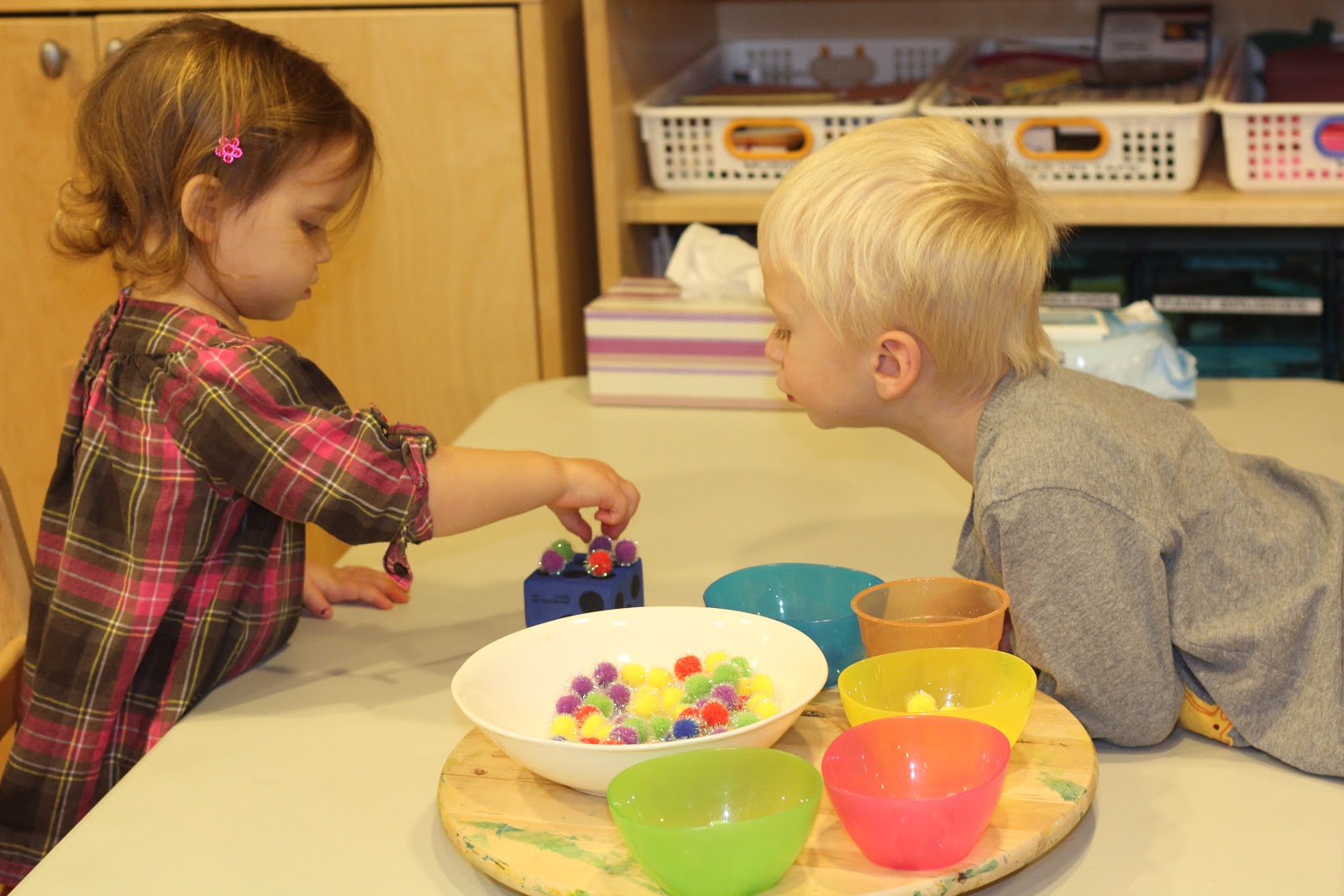
Glittery Pom Pom Math


Pom pom math was wildly popular with all the children but it was tough for all six children to maintain interest while waiting such a long time for their turn. I did have other activities set out but EVERYONE wanted to play this game first so I thought it would be a great opportunity to practice patience and turn taking skills. 

Materials: A large bowl full of glittery, multicolored pom poms, smaller bowls for each color pom pom and giant die. 

(*I placed all these items on a lazy susan to make it easier to pass the game since we had so many children playing at once.)

Rules: Each player tosses the dice then counts the spots. The child chooses the correct number of glittery pom poms then places them in the matching colored bowl.

Skills: counting, matching colors, fine motor skills, turn taking and one to one correspondence.


The children decided to work together on this project in the way I had set it up until each person had two turns. The entire process took about 15 minutes - not bad for a bunch of two and three year olds!

After the initial novelty of the game wore off, many of the children wandered in and out of the game. This was okay by me since the children who were really focused stayed for a long time and didn’t have the distraction of bored friends doing other things at our table. (The wanderers had plenty of other fun things to work on independently.)

Most of our children are two so they are working on counting correctly. Often when these guys count, they say the numbers in correct sequence but they do not come up with the correct cardinal number at the end. For instance they might have a die showing six dots and they counted to 10. This is because they tend to hop around while counting rather than counting in an orderly sequence. This skill is known as one to one correspondence and is an important math concept. 

We practiced counting s-l-o-w-l-y by placing a finger on each dot so we could figure out the correct number of dots on the dice. 

As the game progressed, the children came up with some creative ways to use the materials to further their understanding.

Some children placed a pom pom on each dot to make the number more concrete...


Some children focused on filling the entire surface of the die with pom poms then we counted the pom poms...


and other children decided to just focus on the color sorting aspect of the game...

   In the end we learned that we can all be creative in making up the "rules" to a game as long as everyone has a turn at having fun.

Thursday, October 11, 2012

Letter Links


This morning I made up a game for the kids using some wooden disks and clothes pins inspired by an idea I saw on pinterest. (I would provide you with a link to it but I’m not quite that tech savvy yet.) The original post called for clothes pins and flash cards but I decided to use these wooden disks instead. I love the classic look of the game.

The disks were a donation from a game that one of our daycare families no longer use. We’ve had them for a couple of years and the kids brought them back to life by sorting, counting, building or dropping in them into containers. It was hard to sacrifice the open ended magic of these guys by defining a use for them but I have a feeling this game will be around for a while so it’s worth it.  

The set up was simple: I wrote each letter of the alphabet on the disks then a matching letter on the clothes pins to create a matching game. 


At first I just set the disks and pins on a tray and left it out for the kids to work with, my only instructions were to keep all the pieces at the table so we could find them when we were done. The kids just went to work building trains and stacking towers of disks so I pointed out that the pins and disks had matching letters. The kids got to work putting the matches together but after a while the two year olds gave up. I noticed that while all the children were looking for letters the oldest (3 year old) was the only one with the ability to scan all the pins long enough to find the correct match.


 I decided to make it a little easier by lining up the pins on one side and the disks on the other. Once everything was lined up the kids were much more successful and interested in matching the letters. 


Here Sam is telling Logan how to find the correct match “It has to go down then a bump for the letter D, that’s how you know you got the right one.”

Love it when the kids help each other out!

The surest way to get the boys involved in a literacy project is to add some kind of building element to it, these guys stayed until the whole tray was matched up. After we play the game a few more times I will add lower case letters to the other side of the disks.


Wednesday, October 10, 2012

Fun with mosaics on the light table


Fun with mosaics on the light table...


<a href="http://pinterest.com/daycarediva1/"><img src="http://passets-cdn.pinterest.com/images/about/buttons/big-p-button.png" width="60" height="60" alt="Follow Me on Pinterest" /></a>

The invitation to play was simple: I drew shapes on the top of the light table with window crayons and set out some shapes to see what the kids would do with them.

The youngest tots had fun dumping, sorting and looking at colors....

Some children sorted according to shape by filling in the triangles with triangles 


Squares with squares...


They lined them up in random sequence on the shapes that were not represented in the color tiles and counted them


Or they sorted the tiles according to corresponding shapes and positioned them along the lines to make squares and triangles.


Tuesday, October 9, 2012

All in a day’s work; How preschool curriculum is a natural part of our everyday learning...


I am often asked how kids learn through play and open-ended materials in our daycare environment; after all when people come to visit everyone is having so much rambunctious fun it’s hard to believe they are learning. One reason people may miss the learning experiences as they are unfolding is because young children need to move and make noise in order to learn. “Sit and get” activities are not effective or appropriate with this age group. Also tracking learning up to the age of 5 is challenging, one day your child may know all of her letters but the next time you ask she can only name five. This is a normal part of development. Children are constantly exposed to new information and they need repeated exposure to the same concepts before they stick long term. 

Practice through play makes perfect!

I followed the kids around with my trusty camera and captured some random moments to illustrate the process without all the noise and chaos. Some of these activities lasted 3 minutes others half an hour, as with many things the quality of the play is more important than the quantity of minutes spent doing it. Even though our kids are young we really pack a lot of learning in our day. Some of our projects are planned while others arise spontaneously during free play, my goal as their teacher is to always follow their lead and prepare the environment accordingly. It is my intention to be certain that the lessons I am teaching are relevant and meaningful so that I can influence not only what they learn but how they learn. 

Each morning we have a group discussion around the breakfast table. Sometimes we talk about our families, upcoming projects or emotional events like last night’s boo boo or daddy’s new car. We also make up letter games, look at flash cards, sing silly songs or talk about the weather. Our discussions are loosely planned around observations I make while working with the kids. Everyone is encouraged to participate in these conversations therefore this time together has a tremendous impact on children’s speaking abilities. Listening to each other’s ideas also helps children develop flexible thinking skills and the ability to think / recall / relate to events so that they can expand the way they see the world. 


This morning’s conversation centered around the letter L because one of the children pointed out that LEAF starts with the letter L and today’s project was leaf painting. We thought of other words with the L sound in them, wrote them down and the kids later looked for L’s in the words I wrote as I cleaned up from breakfast. 


 Later we moved on to identifying the colors red, green and yellow. We also strengthened  our hands for writing by pinching eye droppers and carefully working with watercolors. It was tricky for some of the children not to tip the water colors as they worked. We also made a letter L of our very own with bingo dabbers.

      While we were waiting to go outside Logan and Sam organized a table top game where they used paddles to swat balls to each other. Before too long ALL of the other children wanted to play too but we didn’t have enough paddles so we got out plates. We had to do a lot of negotiation. We had to decide how the game should be played, who should go first and what to do if someone was taking too long with the ball. The younger children had the added challenge of getting in and out of their chairs quickly without tipping them; the older children had to be patient while waiting for the younger children to process all that body movement while remembering the rules of the game. 

Once our game was over, we went outside to play with 2x4 s when Sam came up with the idea of positioning them in the shape of a letter T. Some of the kids were not familiar with the letter T so Sam had to figure out how to explain his plan to the other children. He had to use a lot of directional words and the younger children had to watch and listen in order to understand his idea. It took them about 15 minutes and lots of maneuvering to orchestrate his plan but eventually they did it and everyone had a turn walking back and forth across the giant letter T. Talk about full body learning! 
Many of our projects take place in class or do not survive the children’s hands on exploration but rest assured we are learning a lot!

After nap time we had more fine motor fun sorting colors with tiny scoopers. This was a game I saw online and set up for the kids. Will and Sam decided to change the game and make it their own. They added a second cup to each cone and created game where they would fill the clear cup, then scoop the pompoms into the cone and catch it with the colored cup. Imagining two games in one day - pretty creative!


Our second center for the afternoon was one where the children lined up colored tiles on the light table. I set out tiles with a letter L for the children to practice making the letter L, or imagining whatever they wanted to imagine. They took the idea to another level and expanded it by making other letters, rectangles, random designs and dumping / sorting games. 


Our curriculum is very fluid and can change on a dime but if you ask me it’s the only way to teach. Everyone gets to be heard, everyone gets to participate in shaping our days and everyone feels validated for their efforts no matter where they are in their developmental journey. 


Wednesday, October 3, 2012

The building blocks of success


My favorite lessons in daycare land are not ones I had planned; they are lessons that evolve through the children’s interactions with each other when no pesky adults are hovering around mucking things up. They are the moments when everyone in the group has something to give and something to gain based on where they are in their development.

This morning I was working on a math activity with some children, while others were off doing their own thing. Everyone came to visit me for a bit then scampered off to do something else. I was busily recording how the kids were separating items according to size, shape and color when I looked over to see a different kind of math moment unfolding all on it’s own. It came about without any prompting or planning on my part; just some big kids supporting one tiny kid while she worked on her own spatial problem.


This is what I saw.

C was working off to the side with three large blocks trying to stack them up on end so that they were taller than she was. The first few times she tried, they fell over just as she reached up to place the third block on top. After several toppling towers, she figured out she needed to get a little higher to position it correctly; she stretched a little farther and voila! she had her tower. When she was finally successful she wanted everyone to know about it. She grunted excitedly and pointed several times smiling ear to ear, dancing, clapping and marveling at her success. 

L looked up from his cars and smiled, A walked over, rubbed her back and said “Good job C” in the sweetest voice, and S said “Look! C made a tower!” as he grinned ear to ear. J watched. W watched.

We all celebrated her moment  in our own way, then went back to our work.


A few minutes later, C decided she wanted the tower to be taller so she got to work setting the pieces up on top of a milk crate. 
She got the first two bricks set up properly, then she maneuvered her body over to the second milk crate and attempted to set the third block on top. It was a lot of work for her to balance her tiny body on top of the milk crate with a big brick in her hands. She almost fell off a few times maneuvering the uneven crates. 


She had a tough time judging the distance she would need to go to position the block on top of the other unsteady blocks. 

Many times she misjudged and knocked her tower down but each time C patiently set her brick down, climbed off the crate and started the whole process again. 

Then she did it again and again. 

A, W and L all peeked up from their work to watch her from time to time. 

After a few failed attempts, S got up from his work to do it for her. I reminded S that the project was C’s and that she needed to figure it out for herself. I told him that making mistakes is part of learning so it’s important that we respect her space while she’s working. 

S moved off to the side and gave her some verbal feedback on how she could improve her building technique. He said things like, “You’ve got to move it like this C, then you just stack that one there so it won’t fall down.” all the while he positioned his imaginary blocks in the air. L joined in on the advising commity, J and W watched


C looked to her advisors, then to her blocks; then she got back to work. 
We all watched for a while, offering words of encouragement or building advice then we went back to our work.

C kept at it until clean up time. She never was successful in stacking all three bricks on the crate but she did learn that balancing, stacking figuring out distances are tricky work.


More importantly she learned she is surrounded by people who celebrate her successes and that “failure” is just an invitation to try again a different way.